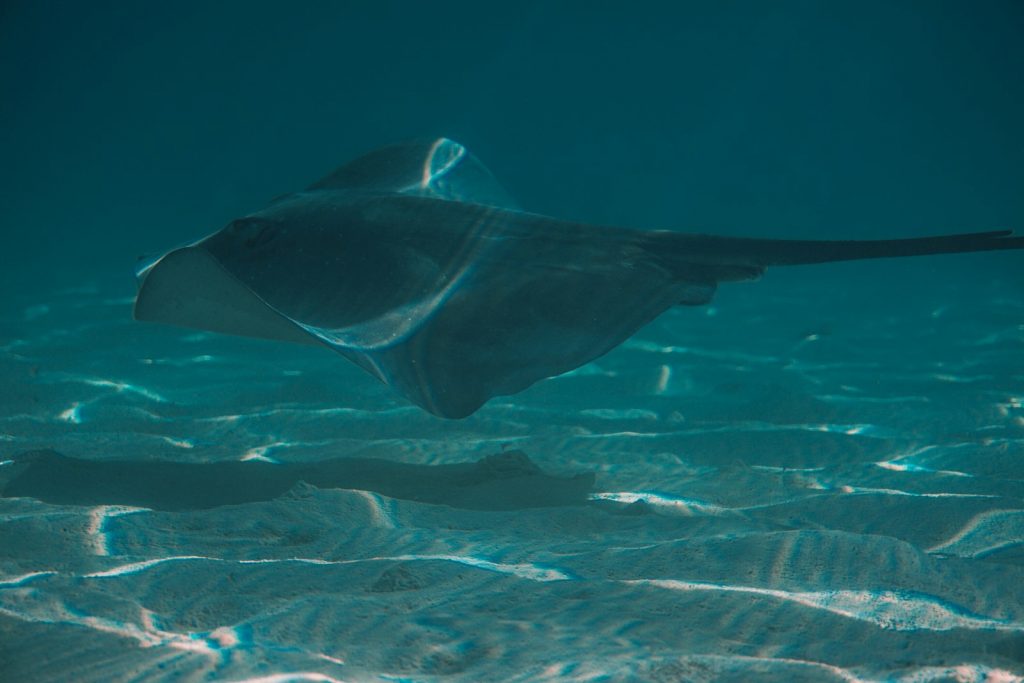
Manta Point Komodo is a drift-snorkel and dive site inside Komodo National Park where reef manta rays often come to feed and be cleaned. For many trips out of Labuan Bajo it’s the single most-asked-about stop — and also the one people misunderstand the most.
You’ve probably seen the photos: a line of mantas, wingtips brushing past snorkellers, drone shots over the white sandbar at Taka Makassar. Real life can look exactly like that. It can also be blue water and no mantas at all.
This guide is the field-notes version. What Manta Point actually is, how manta ray snorkeling in Komodo works day-to-day, why currents and tides matter, and how to fit it into your route without taking silly risks.
—
Where Is Manta Point Komodo, Exactly?
Manta Point sits in the central section of Komodo National Park, east of Komodo Island and north of Padar. It’s part of the narrow strait where strong tidal flows bring in nutrient-rich water – the buffet line that attracts mantas.
Most Labuan Bajo boat itineraries pair it with nearby sites:
– Taka Makassar (the shallow sandbar and reef)
– Batu Bolong (for certified divers)
– Siaba Besar / Turtle Point (more protected snorkeling)
– Padar viewpoint and/or Komodo dragon trekking (if doing a full-day circuit)
From Labuan Bajo town:
– Fast boats: roughly 70–90 minutes to the Manta Point area, depending on sea state
– Standard wooden boats: often 3–4 hours, usually stopping elsewhere first
Locally you’ll hear a few names: “Manta Point,” “Karang Makassar,” sometimes just “Manta.” They’re referring to the same general area: a long, shallow, current-swept reef and channel.
—
What Makes Manta Point Special?
Manta rays use this stretch as:
– A feeding ground – they “fly” against the current with mouths open, filtering plankton
– A cleaning station – small reef fish pick parasites from their skin and gills
– A transit lane – they cruise through on the way between deeper zones
Unlike some dive destinations where manta encounters are deep and technical, manta ray snorkeling in Komodo is usually shallow: often 3–10 m under your fins. That’s why it’s on so many mixed snorkel/dive itineraries.
But that same accessibility hides the main risk: the current.
The whole site functions because water moves here. On some tides that movement is gentle. On others, it rips. Safe visits depend on timing, guide judgement, and guests being honest about their swimming ability.
—
Taka Makassar & Manta Point: How They Fit Together
Manta Point and Taka Makassar are neighbours. Many crews will drop you at both in the same block of time.
What Is Taka Makassar?
Taka Makassar is a small, crescent-shaped sandbar surrounded by shallow reef. At low tide it emerges as a strip of white sand in the middle of bright turquoise water.
People come for:
– Easy, shallow snorkelling (often 1–3 m depth)
– Resting between currenty sites like Manta Point
– Drone shots and photos on the sand
The reef around Taka Makassar has:
– Coral bommies and patches of seagrass
– Reef fish, occasional turtles
– Sometimes passing mantas in slightly deeper tongues of water
Guides will often:
1. Check the current at Manta Point.
2. If it’s too strong or mantas aren’t around, move you to Taka Makassar first.
3. Re-check Manta Point later in the tide.
So when you see “Manta Point + Taka Makassar” on an itinerary from Labuan Bajo, think of it as a flexible block. Crews shuffle the order to match the day’s sea conditions.
—
What a Typical Manta Point Stop Feels Like
Every operator has its own micro-routine, but on the water it usually looks like this.
Boat Approach & Briefing
As your boat enters the area:
– Crew and guides climb to the roof or bow to scan for manta wingtips, dark shapes, and surface feeding lines.
– The skipper does a slow drift along the reef edge to check current direction and speed.
– You get a safety and etiquette briefing.
A good briefing should cover:
– Entry: usually a “giant stride” from the side or a backward roll from a speedboat tender
– Grouping: stay close to your guide and buddy
– No-touch rules: do not chase, ride, or block mantas
– Signal to abort: what to do if the current feels too strong or you feel tired
If you don’t hear clear current and regroup instructions, ask. Currents here are not a joke.
The Drift Snorkel
Most manta ray snorkeling in Komodo at this site is done as a controlled drift:
1. The boat drops you slightly up-current of the area where mantas have been spotted.
2. You enter together and stay in a rough line or cluster behind your guide.
3. You let the current carry you along the reef while scanning ahead and down.
4. After 15–25 minutes, the tender or main boat picks you up down-current.
Sometimes, if mantas are looping in a small area and current is modest, you may snorkel more “in place” instead of drifting far. But that’s not guaranteed.
The Encounter (On a Good Day)
On a good tide, a typical sequence might be:
– First sight: a dark, slow-moving shape at 15–20 m, rising to your depth
– One manta passes below, then another falls into line behind it
– You see barrel rolls – mantas looping through denser plankton patches
– If you stay calm and still, some will cruise right past within a few meters
You’ll also notice:
– Small remoras (suckerfish) on their bellies
– Distinct spot patterns – every manta has a unique ID pattern on its underside
– Often dozens of snorkeling fins on the surface: this is a popular site
On a less-great day, you might get:
– A few passes at depth, just silhouettes
– A quick fly-by from one curious ray, then nothing
– Or, occasionally, zero mantas despite perfect-looking conditions
That last case is frustrating but normal. These are wild animals with big home ranges.
—
Seasonality: Best Time to Visit Manta Point Komodo
You can see mantas year-round in Komodo. But your odds, and how comfortable the surface conditions are, do shift across the year.
Think in two layers:
1. **Wildlife likelihood (manta presence)**
2. **Sea conditions (swell, wind, visibility)**
Broad Pattern Through the Year
This is a general, field-based picture for the central Komodo region:
– **April–June**
– Park has usually dried out after the main rains.
– Seas often calmer; visibility improving.
– Many crews consider this a “sweet spot” for both comfort and manta chance.
– **July–August**
– Southeast trade winds often strongest; surface can be choppy.
– Cooler water, variable visibility.
– Still good manta chances, but less comfortable rides for those prone to seasickness.
– **September–October**
– Winds often ease off.
– Mix of clear days and some early-season storms building.
– Solid manta reports most years.
– **November–March**
– Rainy season peaks late December–February.
– More frequent squalls; occasional trip cancellations in rough weather.
– Some very productive plankton days, but visibility can be murkier.
Within that, mantas respond to plankton and currents more than calendar months. There are weeks in “perfect” season with few sightings, and surprise mega-days off-season.
If Manta Point is a must-try for you and you’re flexible, aim for roughly April–October for a better mix of stable trips and decent water. But understand that no operator can promise manta rays on any date.
—
Currents, Safety & Who Should (and Shouldn’t) Snorkel Here
Let’s talk about the real constraint: current.
How Strong Are Currents at Manta Point?
Komodo sits in the Indonesian Throughflow, a massive exchange between the Pacific and Indian Oceans. The channel around Manta Point funnels that water.
On some tides:
– You’ll feel a gentle push. Easy finning, relaxed drift.
On stronger phases:
– You may move surprisingly fast, even while finning steadily.
– If you drop in the wrong line, you can drift away from the main group quickly.
What most guests underestimate is how tiring repeated drifts can be. Add sun, mild dehydration, and excitement, and people hit their limit sooner than they expect.
Who This Site Is Best For
Strongly recommended:
– Comfortable swimmers who can float and breathe calmly with a snorkel
– People okay with not always being next to the boat (pickups are often from the tender)
– Guests who will listen closely and follow a guide’s hand signals
Be cautious or consider skipping if:
– You are not confident in open water without touching the bottom
– You panic easily if water splashes your face or mask
– You have mobility issues that make ladder re-entry hard on a moving boat
You can still enjoy Taka Makassar and more sheltered spots like Siaba Besar if Manta Point feels too much. Tell your guide honestly; a good crew will not pressure you.
Safety Gear & Practices
Common setups you’ll see:
– **Life jackets or snorkel vests** – offered or required by many boats for Manta Point
– **Surface buoys** – guides often tow one so the tender can track your group
– **Whistles** on vests or with guides for quick signalling
A few personal tips from the field:
– Wear **proper fins**. Barefoot “relax” snorkeling is not for this site.
– If seas are choppy, use an **anti-fogged mask** and practice clearing it calmly beforehand.
– Do not fight the current. If you’re drifting faster than you like, stay horizontal, relax, and focus on staying near your guide and group.
If at any point you feel uncomfortable, signal “OK” then point to the boat or put a hand up – your guide will understand you want to be picked up.
—
Responsible Manta Encounters: How Not to Stress the Rays
Komodo’s manta population is one of its headline attractions. It’s also under pressure: more boats, more fins, more cameras.
The core principle: **don’t change the manta’s behaviour**.
That translates into a few simple rules:
– **No touching, ever**
– Manta skin is covered in a protective mucus. Touching can damage it.
– They’re wild animals, not rides.
– **No chasing or diving down on top of them**
– Let them approach you.
– Fast kicks toward a manta usually send it deeper or away.
– **Stay low and to the side of cleaning stations**
– If your guide points out a bommie where mantas circle slowly, keep distance.
– Swimming right over the cleaning station can shut it down.
– **Limit flash photography and avoid crowding**
– Surface chaos – 30 people splashing in a cluster – is often more stressful than one respectful snorkeller.
If your group is big, rotate time closest to the manta lane instead of building a wall of bodies. The less we feel like a net, the longer they often stay.
—
How Manta Point Fits Into Labuan Bajo Trip Types
You’ll see “Manta Point + Taka Makassar” appear across many different trip styles leaving Labuan Bajo. The big differences are time on site, flexibility with tides, and comfort.
Here’s a simplified comparison:
- Fast-boat day trip (join-in)
-
– Early start, multi-stop circuit (often Padar, Komodo dragons or Rinca, Taka Makassar, Manta Point, one more snorkel).
– Pros: Time-efficient; good for short stays; usually include basic gear and lunch.
– Cons: Fixed schedule; crowding at peak hours; limited flexibility if manta timing is off. - Standard wooden boat day trip
-
– Slower travel; similar stop list, often fewer total sites.
– Pros: More relaxed pace, shaded deck space.
– Cons: Longer transit; can feel rushed at Manta Point if many sites are squeezed in. - 1D1N or 2D1N liveaboard-style trip
-
– Sleep on board; sunrise/sunset at different islands.
– Pros: More flexible on timing; can hit Manta Point when current and light are better; chance to re-try if first pass is quiet.
– Cons: Basic cabins on many boats; higher total cost; seasickness more relevant. - Dedicated dive trip
-
– Certified divers only; Manta Point often one of 2–3 dives that day.
– Pros: Longer in-water time; can see mantas deeper and at cleaning stations less accessible to snorkellers.
– Cons: Less suitable for mixed groups with non-divers; schedules shaped by decompression limits.
Choosing between these depends on your days in Labuan Bajo, budget range, and how manta-focused you are.
If you want help matching your swimming level and time frame with the right style of trip, you can always plan your trip with one of our coordinators over WhatsApp – we keep it practical, not pushy.
—
Reading Conditions: Why Timing in the Day Matters
Most guests think in dates; crews think in tides.
Tide & Current Windows
Guides pay attention to:
– **Tide height and timing** – When is peak flow? When is slack?
– **Direction** – Is water moving northward or southward through the strait?
– **Moon phase** – Springs (around full/new moon) bring stronger currents; neaps are milder.
On strong spring tides, you may still snorkel Manta Point, but:
– The window when current is manageable might be narrow.
– Crews sometimes choose a secondary manta site or different sequence if it’s roaring.
You usually won’t see all this planning, just the result: “We’ll stop at Taka Makassar first, then Manta after lunch” instead of the reverse.
Time of Day & Crowds
Rough patterns (not absolutes):
– Mid-morning to early afternoon is peak boat traffic.
– Early or late passes can be quieter but may not align with your day trip schedule.
Don’t be surprised if there are 5–15 boats in the wider area on a busy day in high season. Good skippers will still find a usable drop line and avoid dropping you on top of another group.
—
What You’ll Actually See Besides Mantas
Even on a manta-light day, Manta Point and Taka Makassar have other life if you look in the right places.
Common sightings at or near Manta Point:
– Eagle rays and smaller mobula rays gliding deeper in the blue
– Green and hawksbill turtles, especially around nearby reefs
– Blue-spotted stingrays on the sand
– Fusiliers, surgeonfish, unicornfish in schools along the reef edge
– Trevallies and snappers hunting in the current
At Taka Makassar’s shallow reef:
– Damsels, wrasses, butterflyfish on coral patches
– Juvenile fish using seagrass as shelter
– Sometimes baby blacktip reef sharks cruising the shallows (completely uninterested in snorkellers)
You won’t get the dense coral gardens of sites like Batu Bolong here, but the combination of shallow water, colours, and wide-angle scenes is very photogenic.
—
Gear, Comfort & Seasickness Tips
Gear Checklist
Most Labuan Bajo operators include masks, snorkels, and fins, but quality and fit vary. For Manta Point specifically, consider:
– **Your own mask** – biggest upgrade you can bring; prevents leaks and fog.
– **Shorty wetsuit or rash guard** – for sun, jellyfish stings, and warmth on long days.
– **Reef-safe sunscreen** – applied at least 20–30 minutes before water time.
– **Strap for sunglasses and hat** – boat decks get windy.
– **Dry bag** – protect phone, camera, and a dry change of clothes.
If you wear glasses, ask in advance about prescription mask options or bring contact lenses; struggling to see mantas because your mask fogs or floods is avoidable frustration.
Seasickness & Long Boat Days
That ride from Labuan Bajo out to central Komodo can feel long on a choppy day.
Field-tested tips:
– Take your preferred seasickness meds **30–60 minutes before departure**, not after you feel bad.
– Eat a light, non-greasy breakfast; avoid heavy fried foods.
– Stay on deck in fresh air and look at the horizon while underway.
– Hydrate slowly through the day; many people mistake mild dehydration for motion fatigue.
If you know you’re very motion-sensitive, tell the crew at boarding. They may be able to position you better or check in more frequently.
—
Costs: What You’ll Pay to Reach Manta Point Komodo
Prices shift with fuel, park regulations, and demand, but broad patterns for trips that include Manta Point + Taka Makassar from Labuan Bajo look roughly like this (ranges, last verified June 2026):
– **Join-in fast-boat day trips:**
– Often in the range IDR 1.2–2.5 million per person
– Usually include: boat, guide, lunch, basic snorkel gear
– Exclude or separately itemise: Komodo National Park fees, hotel transfers
– **Join-in wooden boat day trips:**
– Roughly IDR 700,000–1.700,000 per person
– Slower and usually fewer sites or shorter time at each
– **Overnight / multi-day boats:**
– Wide range from more basic shared-cabin trips up into higher-end options
– Per-person daily rates can start in the low millions of rupiah and climb significantly with comfort and cabin type
– **Dedicated dive days (certified divers):**
– Often priced per dive day including 2–3 dives, equipment rental optional/extra
– Snorkelling friends sometimes pay a lower participant fee if space is available
On top of boat costs, factor in:
– **Komodo National Park and ranger fees** – structured by activity (trekking, diving, snorkelling, camera types) and day of the week; these are paid per person and can be a significant part of your total.
– **Gear rental upgrades** – wetsuits, private guides, underwater cameras where offered.
If pricing feels opaque, ask operators for a clear breakdown of:
1. Boat/trip price
2. Park fees (estimate per person, per day)
3. What gear is included or extra
If you’d like a realistic budget for your dates and group size without any sugar-coating, you can plan your trip with our team via WhatsApp – we can talk through options that include Manta Point and what you might sensibly skip.
—
Photography & Drones at Manta Point and Taka Makassar
Underwater Cameras
Action cameras like GoPros are everywhere now. To get usable manta footage:
– Use a **wrist or hand grip**, not a selfie stick waved in front of other snorkellers.
– Set a wide field of view; mantas are big and often closer than you think.
– Prioritise **being stable and relaxed** over chasing a perfect angle.
If you’re new to snorkeling, consider skipping the camera on your first drift. Get your breathing and buoyancy comfortable first, then add gadgets on a second pass if there is one.
Drones
Taka Makassar is drone central on some days.
Before flying:
– Check park and local rules – regulations evolve, and there may be restrictions on launch points or altitudes.
– Be mindful of noise and privacy – not everyone wants a buzzing drone overhead while they rest.
– NEVER fly close to wildlife, boats under way, or people in the water.
Keep in mind many smaller boats don’t have ideal, stable launch/landing spots. Don’t risk your drone or other guests for a shot.
—
Setting Your Expectations Right
If manta point Komodo is the emotional centre of your trip, set expectations like this:
– You are **very likely** to at least snorkel the site if weather allows your boat out.
– You are **quite likely** to see mantas at some distance over a full-day or multi-day visit in the right season.
– You are **not guaranteed** close, cinematic encounters – those happen, but they’re not a product, they’re a gift.
The real win is often broader:
– Drifting over a working reef in strong ocean water
– Learning to read current, not fear it
– Seeing how many pieces – plankton, fish, rays, tides – fit together
Treat close manta passes as a bonus, not the entitlement, and you’ll enjoy whatever the ocean decides to show you.
—
Is Manta Point suitable for children?
It depends on the child’s swimming ability and confidence in currents. Strong, water-confident kids who are comfortable with masks and fins can enjoy it with life jackets and close supervision. For younger or less confident children, Taka Makassar and more sheltered snorkel sites are usually a better choice while one adult sits out Manta Point with them on the boat.
Can beginners snorkel at Manta Point Komodo?
Beginner swimmers can technically snorkel there with life jackets and a close guide, but strong currents can feel overwhelming. If you’re not comfortable in open water, it’s safer to treat Manta Point as optional and focus on easier sites; you can always decide on the day after hearing the guide’s current report.
How long do you usually spend in the water at Manta Point?
Most drifts last around 15–25 minutes each, depending on current and conditions. Some trips do one long pass; others may offer two shorter drifts if timing and boat schedule allow. Exact water time varies with sea state, group ability, and how many other sites are on the day’s plan.
Do I need to be a certified diver to see mantas here?
No. Manta ray snorkeling in Komodo is often as rewarding as diving, because many rays feed and cruise in shallow water. Divers may see different behaviours at deeper cleaning stations, but snorkellers regularly get excellent encounters near the surface.
What happens if conditions are bad or there are no mantas?
If sea or current conditions make Manta Point unsafe, crews usually substitute another snorkel site or spend more time at nearby Taka Makassar or Siaba Besar. If you visit and see no mantas, there is normally no refund or repeat built in; sightings are never guaranteed. This uncertainty is part of watching wild animals in an open ocean, not an aquarium.