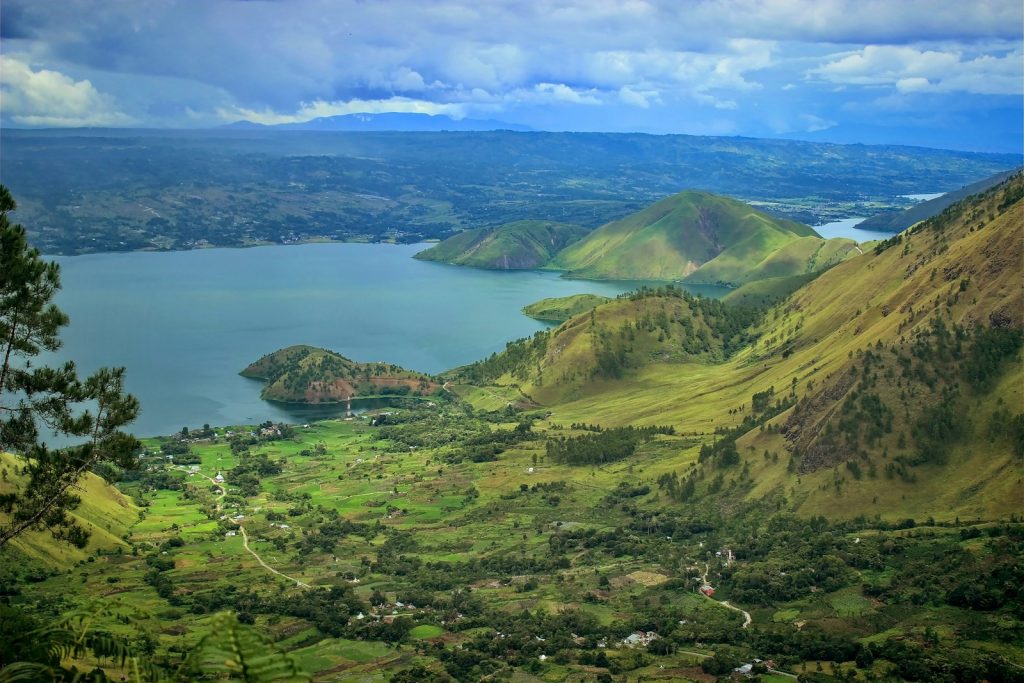
A kelimutu lake tour is a trip to see three volcanic crater lakes on Mount Kelimutu in central Flores, famous for constantly changing colours. For most travellers it means waking before dawn in the village of Moni, then hiking to catch Kelimutu sunrise over the tri-colour lakes of Flores.
What is Kelimutu, really?
Kelimutu is a dormant volcano near the town of Ende, in central Flores. On its summit sit three separate crater lakes. They share one mountain, but each lake can be a different colour: turquoise, deep green, dark brown, almost black, even milk-chocolate or pale blue. The colours shift over months and years due to dissolved minerals and volcanic gases reacting with oxygen and sunlight.
Locals call the mountain “Keli Mutu” — roughly, “the boiling mountain” in the local Lio language. Each lake has a name and a spirit story:
– Tiwu Ata Bupu – the Lake of Old People
– Tiwu Ko’o Fai Nuwa Muri – the Lake of Young Men and Maidens
– Tiwu Ata Polo – the Lake of Bewitched or Evil Spirits
The science and the stories sit side by side here. Government signs talk about iron and sulfur. Older villagers talk about ancestors and omens. Both are part of a kelimutu lake tour.
Where is Kelimutu, and how far is it from Labuan Bajo?
Kelimutu lies in Kelimutu National Park, about 50 km east of Ende and 13 km above the village of Moni. Labuan Bajo, at the western tip of Flores, is your likely starting point.
Flores is long. The distance from Labuan Bajo to Moni is roughly 620–650 km by the overland route, depending on detours. Because most of this is winding mountain road, travel is slow. Think in hours, not kilometres.
Here’s a reality check for getting to Kelimutu from Labuan Bajo.
- Route
- Labuan Bajo – Ruteng – Bajawa – Ende – Moni (by road)
- Typical overland duration
- 2–3 full days of driving one way, with sightseeing stops
- Fastest “hybrid” option
- Fly Labuan Bajo – Ende, then 1.5–2 hours by car to Moni
- Nearest airport
- H. Hasan Aroeboesman Airport (ENE) in Ende
- Best season
- Generally April–October for clearer skies; wet season has more cloud and rain
No sugar-coating: Kelimutu is far from Labuan Bajo. It’s not a casual day trip like Komodo. You either commit to an overland Flores journey or add a domestic flight.
Why do people go? The tri-colour lakes experience
The visual shock of three colours
You stand at the main viewpoint, about 1,690 m above sea level. Two lakes sit side by side in a single massive crater, separated by a thin rock wall. The third is slightly behind you, in its own bowl. Early light creeps over the rims and the colours appear.
Sometimes it’s a perfect postcard combo: electric turquoise in one basin, deep bottle-green in another, a dark almost-black pool below the next cliff. Other times one might be muddy brown, or all three muted by cloud shadow. The lakes don’t care about your Instagram.
From a distance the colour blocks are dramatic. Look closer: behind the big colours you see subtle layers and streaks on the crater walls where waters have shifted over time.
The sound of a quiet volcano
Kelimutu is not erupting, but it isn’t silent. Depending on the day you might hear faint fizzing sounds, smell a whiff of sulfur, or see light steam drifting up in the morning chill. It reminds you this mountain is still alive underneath.
The national park keeps you at a safe distance with railings and marked paths. Do not step beyond them. The crater walls are steep and crumbly, and the lakes are extremely acidic.
The cultural layer
For the Lio people around Moni, Kelimutu is not just a viewpoint. It’s a meeting place for souls. Families sometimes visit to speak to ancestors, bringing betel nut or cigarettes as offerings. On August 14 each year, locals and officials hold a traditional ceremony at the summit with prayers, food, and dancing.
Even on an ordinary morning you often see older women in ikat cloths quietly praying at the corner of the viewpoint platform, away from the selfie crowd. Give space. Keep your voice low. You’re walking through a living belief system, not a theme park.
Kelimutu sunrise: what the pre-dawn visit is actually like
Most visitors aim for one thing: kelimutu sunrise. The lakes are open all day, but dawn has a particular pull. Here’s how the classic Moni sunrise visit usually runs.
Wake-up and drive from Moni
– Typical wake-up: 3:30–4:00 am
– Drive time Moni – Kelimutu parking: 30–45 minutes on a narrow mountain road
– Road quality: sealed but patchy in spots; wet-season potholes possible
You can go with a local driver or on a motorbike. Driving in the dark in heavy rain and fog is not fun if you don’t know the road. For most travellers, a local driver is the less stressful option.
At the entrance gate you pay the Kelimutu National Park fee (varies by nationality and weekday/weekend; usually split into entrance + vehicle + insurance). Bring cash in Indonesian rupiah.
The final hike to the viewpoint
From the parking area at the end of the road, you walk:
– Distance: about 1.5 km one way
– Time: 20–35 minutes at a normal pace
– Path: paved steps and concrete path, with handrails on most of the steeper sections
You hike in the dark, using phone torches or a headlamp. It’s chilly at the top. Wind can cut right through sweaty T-shirts. Bring:
– A light jacket or fleece
– A hat or beanie
– Proper shoes or sandals with grip (the path can be wet and slippery)
The walk is short but still a bit of a climb. If you have heart or respiratory issues, take it slowly. There are benches at a couple of rest points.
At the top: waiting for light
The main viewpoint is a concrete platform with railings. On busy days there can be 100+ people up there in high season. On quiet days it’s you, a couple of locals, and a few dogs sharing the wind.
What happens between 5:00 and 6:00 am:
– First, total darkness. You see nothing but feel the drop.
– Then, a pale blue band on the horizon beyond Mt. Inerie and the central Flores highlands.
– Slowly, the shapes of the lakes appear. Colours arrive last, as the sun climbs high enough for the rays to reach down into the craters.
Some mornings everything is clear. Some mornings heavy fog rolls in and out, hiding and revealing the lakes like curtains. Some days the cloud never lifts properly and colours stay flat.
No guide can promise you a perfect sunrise. That’s the honest part of a kelimutu lake tour.
Still, even imperfect mornings have their own drama. Watching clouds stream past a volcanic rim at 1,600+ metres has its own energy.
After sunrise: walking the side trails
Once the light is up, you can:
– Walk to alternative viewpoints along the rim for different angles
– Look back towards the mountains of central Flores as the landscape reveals itself
– Watch sun rays slide across the lakes and see the colours deepen
Allow about 1–1.5 hours at the summit before walking back down. Many visitors are back in Moni by 8:00–8:30 am for breakfast.
Season, weather and expectations
Flores has a marked dry and wet season, but local microclimates matter.
Dry season (roughly April–October)
– Generally clearer mornings, especially June–September
– Cooler nights, sharper air at the top
– Higher visitor numbers in July–August
– Dustier roads, easier driving
Even in dry season, cloud can still cover the summit, especially if there’s a general weather system moving through. Don’t assume “dry season” equals “perfect sunrise”.
Wet season (roughly November–March)
– More rain, heavier cloud, tricky driving after dark
– Some mornings still clear, others fully socked in
– Fewer visitors; quieter paths and viewpoints
If you come in the rains, build extra time into your plan. You may want two mornings in Moni to increase your odds of a good view. And bring real rain protection — a poncho and something to keep your small bag dry.
How to reach Kelimutu from Labuan Bajo
There are two main ways to add Kelimutu to a Labuan Bajo trip:
1. Overland across Flores
2. Fly-in via Ende or Maumere, then drive to Moni
Both have pros and cons.
1. Overland Flores: road trip from west to east
This is the classic Flores journey. You start in Labuan Bajo and travel east by road, stopping in mountain towns and villages along the way. Kelimutu is a highlight near the end.
Typical west–east route:
– Labuan Bajo – Ruteng – Bajawa – Ende – Moni – (optionally on to Maumere)
Approximate driving segments (excluding long stops):
– Labuan Bajo – Ruteng: 4–5 hours
– Ruteng – Bajawa: 4–5 hours
– Bajawa – Ende: 4–5 hours
– Ende – Moni: 1.5–2 hours
Most travellers take 4–7 days Labuan Bajo to Moni, using days between drives to explore:
– Traditional villages near Ruteng and Bajawa
– Rice terraces and mountain valleys
– Hot springs, cascades, coffee areas
You won’t be bored between towns. But your body will feel the curves. Flores is almost never straight.
This overland choice makes sense if:
– You have at least a week total for Flores
– You enjoy road journeys and daily re-packing
– You want a deeper sense of the island beyond Komodo and Kelimutu
If you only have 3–4 days, an overland kelimutu lake tour from Labuan Bajo is not realistic. You’ll spend most of your time sitting in a car.
2. Fly-in: Labuan Bajo to Ende or Maumere
If your priority is “Komodo + Kelimutu” in one visit, and you’re short on time, flying is usually smarter.
Main airports:
– Labuan Bajo (Komodo Airport, LBJ) – western Flores
– Ende (H. Hasan Aroeboesman Airport, ENE) – closest to Kelimutu
– Maumere (Frans Seda Airport, MOF) – further east, but also a gateway
Typical pattern:
– Finish your Komodo boat trip and Labuan Bajo stay
– Fly Labuan Bajo – Ende (often via Kupang or Denpasar, depending on airline)
– Drive Ende – Moni (1.5–2 hours)
– Overnight in Moni
– Kelimutu sunrise next morning
– Then either fly out from Ende or continue overland east to Maumere
There are no reliable same-day public transport options that allow you to fly into Ende and reach Kelimutu for sunrise. Plan at least one night in Moni before your summit visit.
Public transport vs private car
Between Labuan Bajo and Ende you technically can use public buses and shared minibuses. They:
– Are cheaper than private cars
– Take longer
– Often run on “Flores time” (loose schedules, roadside pick-ups and drop-offs)
For most travellers trying to coordinate a Kelimutu sunrise, a private car with driver is more practical. Costs depend on distance, number of days, road conditions and fuel prices (last verified June 2026). Expect per-day car-and-driver rates across Flores to sit in a mid-range band; not Jakarta-cheap, not Bali-high. Get a written or WhatsApp-logged quote including fuel and driver accommodation.
If you’d like a sanity check on routes and realistic day-by-day plans, we can help sketch an itinerary: plan your trip with us via WhatsApp and we’ll be candid about what fits your time and budget.
How to fit Kelimutu into a Flores itinerary
Let’s look at three common patterns for combining Kelimutu with Labuan Bajo and Komodo.
Option A: Komodo + quick Kelimutu (4–5 days)
Best for people who want to “touch” both icons with limited time.
Sketch:
– Day 1: Arrive Labuan Bajo, overnight
– Day 2: Komodo National Park day trip (dragons + snorkelling), overnight Labuan Bajo
– Day 3: Morning flight Labuan Bajo – Ende, drive to Moni, sunset viewpoints or village walk
– Day 4: Kelimutu sunrise, then drive back to Ende for afternoon flight onwards
If flights don’t line up nicely, add a buffer day. Do not stack tight connections in Flores — delays happen.
Option B: Flores west–east road trip (7–10 days)
Best if you care about the “in between” as much as the big names.
Sketch:
– Day 1: Arrive Labuan Bajo
– Day 2–3: Komodo liveaboard or 2 day trips
– Day 4: Drive to Ruteng, stop at spiderweb rice fields
– Day 5: Drive to Bajawa, visit Ngada villages, hot springs
– Day 6: Drive to Ende, coastal and mountain stops
– Day 7: Drive to Moni, easy afternoon, early night
– Day 8: Kelimutu sunrise, then either back to Ende or onward to Maumere
You can stretch this by adding extra nights in Ruteng or Bajawa, or by spending a second night in Moni to allow two sunrise attempts.
Option C: East Flores focus with Kelimutu (5–7 days)
Some travellers finish Komodo and then focus on the eastern side.
Sketch:
– Day 1–3: Labuan Bajo + Komodo
– Day 4: Fly to Maumere, explore nearby villages/coast
– Day 5: Maumere – Moni by road, late afternoon arrival
– Day 6: Kelimutu sunrise, back to Moni or down to Ende
– Day 7: Fly out from Ende or Maumere
Talk to us if you want to gut-check logistics before committing — we can walk through connections and driving times over WhatsApp in a plan your trip session.
Overnight in Moni: where you actually stay
Moni is a small hillside village on the road between Ende and Maumere. It exists in its current form largely because of Kelimutu.
What to expect in Moni
– Altitude: cooler than the coast; nights can be properly cold in the June–August dry season
– Accommodation: a mix of small guesthouses, homestays, and a few more polished lodges
– Food: simple warungs and some traveller cafés; think fried noodles, rice dishes, grilled fish, banana pancakes, coffee and tea
Electricity cuts still happen occasionally. Hot water can be unreliable in the budget options. If hot showers matter, confirm clearly with your host.
What to do besides Kelimutu
If you have a full day before or after your kelimutu lake tour, you can:
– Walk through nearby rice terraces
– Visit local villages to see Lio ikat weaving
– Bathe in river or roadside hot springs (ask locals which ones are currently safe and accessible)
– Watch afternoon light over the steep valley walls
Moni is not a party town. Bring a book, charge your camera, and let the mountain air slow you down.
Costs and fees: what you actually pay
Exact numbers shift with fuel, inflation, and policy changes, but here are the main buckets you should budget for (ranges last verified June 2026):
1. Park entrance and local logistics
You’ll typically pay:
– Kelimutu National Park entrance fee per person (different for Indonesians and foreigners, and may differ on holidays/weekends)
– Vehicle fee (car or motorbike)
– Optional local guide (not mandatory but good if you want context)
– Parking at the trailhead
These are all cash-on-the-day costs. There’s no need to pay any of this months in advance through a middleman unless it’s bundled into a larger private tour.
2. Transport, accommodation and food
Budget segments separately:
– Labuan Bajo – Ende or Maumere flights: domestic Indonesian fares can move a lot week to week; book early for more predictable pricing.
– Private car + driver across Flores: commonly priced per day, including driver’s food and lodging, plus fuel.
– Moni guesthouse: low to mid-range per night depending on comfort level and season.
Food is generally inexpensive by global standards, especially if you eat at local warungs. Simple Indonesian dishes will usually be your cheapest option. Western-style menus in traveller cafés and hotel restaurants cost more.
3. Tours vs DIY
You can:
– Book a bundled Flores overland tour with Kelimutu included
– Just arrange a driver and pay park fees yourself
– Use local ojek (motorbike taxi) from Moni to the trailhead
A packaged kelimutu lake tour isn’t inherently “better”. It simply moves the admin from you to someone else. The trade-off: you lose some flexibility, but you don’t need to juggle drivers, flights and sunrise wake-up times yourself.
Our stance as editors: choose the level of organisation that matches your comfort with uncertainty. Flores rewards some flexibility, but too much last-minute decision-making in high season can leave you stuck with poor connections.
Is Kelimutu “worth it” from Labuan Bajo?
This is the question many people quietly ask.
Honest answer: it depends what kind of traveller you are and how many days you have.
It usually *is* worth it if:
– You’re already planning a Flores overland journey of 6+ days
– You’re drawn to volcanoes, geology, and cultural landscapes
– You’re okay with long driving days and basic lodging outside main towns
It’s *maybe not* worth it if:
– You only have 2–3 days in total on Flores
– Your main dream is snorkelling and you’re indifferent to mountains
– You strongly dislike early wake-ups, cold mornings and the chance of cloud blocking your view
From Labuan Bajo, Komodo National Park alone can easily fill 2–4 rich days of dragons, reefs, and islands. Adding Kelimutu turns that into a Flores journey, not a quick side trip.
If you’re on the fence, send us your dates and priorities via plan your trip and WhatsApp. We’ll tell you plainly if Kelimutu fits or if it will just make your trip feel rushed.
Practical tips from a Flores local
After years guiding and then writing about this mountain, these are the points I repeat most.
Give yourself one buffer
If Kelimutu is a top priority, plan two potential sunrise mornings in Moni. Use the second only if the first is lost to cloud or heavy rain. That small buffer often makes the difference between disappointment and satisfaction.
Pack for contrast
Flores from coast to mountain in a single trip means:
– Heat and strong sun on Komodo boats
– Cool, damp pre-dawn air at 1,600+ m on Kelimutu
Bring:
– A light but real jacket
– Long trousers for the summit morning
– A hat and sunscreen for the boat days
– A dry bag or cover for electronics
It sounds basic, but many people arrive in Moni with only board shorts and a thin T-shirt in their backpack. The summit wind teaches them quickly.
Stay behind the rails
This is not just park messaging. The crater rims are steep, often undercut, and can crumble unexpectedly after big rains. There have been accidents over the years. No photo is worth gambling with that.
Respect the quiet
The lakes are a sacred place for many locals. That doesn’t mean you can’t laugh or take photos. It does mean:
– Keep music in your headphones, not on speakers
– Lower your voice at the top
– Give space to anyone clearly praying or making offerings
You’ll feel the difference in atmosphere when everyone treats the space with at least a basic level of care.
Be honest with your energy level
If you’ve just finished a 3-day Komodo liveaboard, you may be sun-tired and a bit dehydrated. Stacking a long travel day straight into a 3:30 am wake-up can make Kelimutu feel like a chore, not a gift.
It’s okay to insert a “do very little” day in Ende or Moni before the sunrise, just to let your body catch up. Flores is not a race.
At a glance: overland vs fly-in for Kelimutu from Labuan Bajo
| Option | Pros | Cons | Best for |
|---|---|---|---|
| Overland Labuan Bajo – Moni | See central Flores, villages, volcano views; deeper sense of the island | 2–3 days of driving one way; winding roads; more nights on the move | Travellers with 7–10 days and curiosity beyond “must-sees” |
| Fly Labuan Bajo – Ende | Fastest; less road fatigue; easier to squeeze into short trips | Flight schedules, potential delays; miss central Flores scenery | Time-poor visitors wanting Komodo + Kelimutu in 4–5 days |
| Fly Labuan Bajo – Maumere then road | Combines Kelimutu with east Flores coast; flexible loop options | Longer drive to Moni than from Ende; more planning complexity | Those drawn to east Flores culture and coast as well as Kelimutu |
Final thoughts
Kelimutu is not just a coloured-lake photo stop at the end of a paved road. It’s a long pull from Labuan Bajo, a cold dark walk before dawn, and a meeting point of science and belief high on a volcanic rim.
If you give it the time and respect it needs, a kelimutu lake tour can anchor your Flores journey in a way that balances Komodo’s sea level magic with something older and quieter in the mountains.
If you’d like help threading Komodo, Kelimutu and the places between into one coherent trip, share your rough dates and interests with us via plan your trip. We plan over WhatsApp, we’re upfront about trade-offs, and no one can pay to change what we publish; if you proceed with our partner they may pay us a referral fee at no extra cost to you.
How many days do I need for a Kelimutu trip from Labuan Bajo?
For a fly-in visit focused on Kelimutu and Komodo, plan at least 4–5 days. That usually gives you 1–2 Komodo days, a travel day to Ende/Moni, and one sunrise morning on Kelimutu. If you want to travel overland across Flores, you’re looking at 7–10 days to do it without rushing.
Can I visit Kelimutu as a day trip from Labuan Bajo?
No, a day trip is not realistic. The distance is too great and there are no regular flights early enough and back late enough to combine with a pre-dawn hike. You need at least one night in Moni before a Kelimutu sunrise visit, and realistically a travel day to get there from Labuan Bajo.
Is the Kelimutu hike difficult?
The hike from the parking area to the main viewpoint is short but uphill: about 1.5 km each way on a paved path with steps. Most reasonably fit people manage it in 20–35 minutes. What makes it feel harder is the pre-dawn cold, the altitude, and sometimes wet or slippery steps. Take your time and bring a jacket and proper shoes.
When is the best time of year to see the tri colour lakes Flores?
Generally April to October offers clearer, drier conditions, especially June–September. That said, lake colours can look muted on any given day if cloud shadow covers them, and you can still get excellent mornings in the wet season between rain systems. Aim for early dry season if you can, but understand that weather and colour intensity are never guaranteed.
Can I swim in the Kelimutu lakes?
No. Swimming is forbidden and extremely dangerous. The lakes are very acidic, the crater walls are steep and unstable, and access down to the water is unsafe. Enjoy the view from the marked paths and platforms only.